
(Babylon Rising: Is the Strait of Hormuz Preparing the Way for Revelation 18?)
For generations, prophecy teachers have attempted to relocate end-times Babylon. Some identify it as Rome. Others believe it represents New York City, the United States, Europe, or an abstract worldwide economic system. However, these interpretations begin with current events or theological assumptions and then read those ideas back into Scripture.
The historical-grammatical method requires us to begin with the biblical text. We interpret words according to their normal meaning, grammar, historical setting, and context. Symbols certainly appear in prophetic literature, but symbols do not give an interpreter permission to make a biblical location mean anything he chooses.
The basic interpretive rule is straightforward: When the Bible says Babylon, it means Babylon unless the context clearly tells us otherwise.
Babylon was an actual city in the land of Shinar in what is now modern Iraq. Scripture never identifies Babylon as New York, America, or Europe. Those associations must be imported from outside the Bible.
Recent developments in Iraq are therefore worth attention—not because they prove that Revelation 18 is being fulfilled today, but because they show how the infrastructure needed for a future commercial Babylon could develop far more rapidly than many once imagined.
Patrick Wood and the New Commercial Corridor
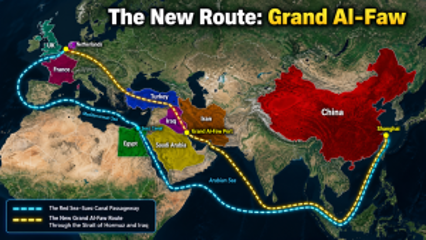
Pastor Tom Hughes and I recently interviewed Technocracy researcher Patrick Wood, and he drew attention to Iraq’s rapidly expanding commercial infrastructure. Central to these developments is the Grand Faw Port in southern Iraq and the nation’s massive Development Road project. Patrick Wood Interview
The plan is to receive shipping from Asia through the Strait of Hormuz and the Persian Gulf at Grand Faw, then transport commodities northward across Iraq using railroads, highways, logistics centers, and economic corridors. From Turkey, those goods could continue into Europe.
Wood observed that this emerging route could carry international commerce remarkably close to the ancient site of Babylon. In his words, “the trade of the world could be routed close to Babylon.” He estimated that the route could pass approximately 50–60 miles from the ancient city. Patrick Wood Interview
Wood has also highlighted Iraq’s plan to make Grand Faw one of the largest commercial ports in the Middle East. He describes the port and Development Road as competitors to other proposed economic corridors connecting Asia with Europe. Patrick Wood, “Iraq’s Al-Faw Grand Port to Be the Largest Facility in the Mideast”
These projects are not merely speculation. Reuters reported that Iraq launched the $17 billion Development Road project to connect its southern port with the Turkish border by rail and highway. The stated objective is to turn Iraq into a major international transit hub and create a shorter commercial route between Asia and Europe—one that can compete with the Suez Canal. Grand Faw is expected to handle millions of shipping containers as its capacity expands. Reuters report on Grand Faw and the Development Road
Iraq, Turkey, Qatar, and the United Arab Emirates have already signed a preliminary agreement to cooperate on the Development Road. This means Iraq’s transformation is not an isolated national dream. It is increasingly tied to international capital, regional partnerships, global shipping, and the economic interests of surrounding nations. Reuters report on the Development Road agreement
We must be careful: Grand Faw is not Babylon, and the Development Road is not the fulfillment of Revelation 18. Nevertheless, these developments could establish the commercial environment in which a rebuilt Babylon eventually rises to global prominence.
When Scripture Says Babylon, It Means Babylon
Interpreters often identify Babylon with whichever modern power appears most influential now. When Britain dominated world trade, some saw Babylon in the British Empire. As American power increased, others moved Babylon to New York or the United States. Still others point to Rome, the European Union, or a global banking network.
But current prominence is not a sound hermeneutic. If “Babylon” can mean New York today, Brussels tomorrow, and another city ten years from now, the text no longer controls the interpretation. The interpreter does.
The Babylonian system has certainly influenced governments, religions, and economies throughout history. But a worldwide Babylonian system does not guarantee the future existence of a literal city called Babylon. An ideology can be global while still possessing a geographical headquarters.
Scripture repeatedly identifies Babylon as a city. The Old Testament locates it in Shinar. The prophets predict its final destruction. Zechariah depicts wickedness returning to Shinar. Revelation brings Babylon to the climax of its political, religious, and commercial power before God permanently judges it. The most natural conclusion is that Babylon means Babylon.
The burden of proof belongs to those who move Babylon away from Iraq. Babylon had a known geographical location, historical identity, culture, and prophetic future. A consistent, historical-grammatical interpretation does not relocate the city simply because its future restoration once appeared politically or economically impossible.
Babylon will be rebuilt and will become the Antichrist’s political and economic capital. The prophecies concerning Babylon’s final destruction have never been completely fulfilled and therefore require the city to be rebuilt near where ancient Babylon stood in present-day Iraq.
Scripture also predicts that even though Babylon will be rebuilt, it will be utterly destroyed in one hour. Isaiah 13:19–22 predicts that Babylon will be overthrown like Sodom and Gomorrah and will never again be inhabited from generation to generation. Jeremiah 50–51 similarly describes a complete, permanent, and catastrophic destruction.
That did not occur when the Medes and Persians captured Babylon in 539 B.C. The city fell without the kind of once-and-for-all destruction Isaiah and Jeremiah described. In fact, after the Persians took over, Darius appointed Daniel as one of the realm’s supreme administrators in Babylon. It remained inhabited for centuries. Alexander the Great entered Babylon and intended to restore it as a center of his empire. Its eventual decline was gradual, not the sudden, supernatural destruction portrayed by the prophets.
Therefore, either the prophecies failed, the words must be redefined, or Babylon must be restored in the future, followed by a final destruction. A literal hermeneutic accepts the third conclusion.
The Biblical Boomerang Effect
This also illustrates what might be called the biblical “boomerang effect”: what begins at a particular place in biblical history frequently returns to that location for its final resolution. God lets the rebellion come full circle, then destroys it where it began.
Babylon begins in Genesis 10–11 with Nimrod, Babel, and the land of Shinar. Humanity united in organized rebellion against God and attempted to establish a centralized civilization independent of Him. Babel represented more than an unfinished tower. It was an early concentration of political power, economic cooperation, false religion, and human pride.
God judged that rebellion by confusing humanity’s language and scattering the nations, giving them over to the authority of the fallen “bene Elohim” (sons of God) they worshiped.
“When the Most High divided the nations, when he separated the sons of Adam, he set the bounds of the nations according to the number of the sons of God. (Deuteronomy 32:8 – LXX & Dead Sea Scrolls 4QDeut^j (4Q37) and 4QDeut^q (4Q42))
Yet Babylon’s spirit did not disappear. Its idolatry, political tyranny, occult religion, economic seduction, and its continued hatred of Israel and eventually the Church continued through subsequent civilizations. What began geographically at Babel spread throughout the world.
The boomerang eventually returns. Zechariah 5:5–11 presents wickedness being transported in the future to “the land of Shinar.” The woman in the basket represents wickedness, ultimately pointing toward the religious dimension of Babylon—the harlot system of Revelation 17. The ephah, a standard unit used in commerce, represents the economic system. But this is not righteous commerce; the lead-weight imagery points to a corrupt and deceptive economic order.
What matters most is where this system is taken: the land of Shinar—Babylonia. The prophecy does not relocate Babylon to New York, Rome, Europe, or some other symbolic location. It points back to the geographical place where Babylon began.
The picture, then, is of religious wickedness joined with a corrupt global economic system, ultimately returning to its ancient home in Babylon. This fits the end-times picture in Revelation: rebuilt Babylon becomes a major center of religious, economic, and political power during the Tribulation. What began at Babel in the land of Shinar ultimately comes full circle—the rebellion that began there returns there, reaches its final form, and God judges it there. A house is prepared for the Babylonian system, and there, its corrupting influence religiously, economically, and politically will be protected and allowed to exert control over the entire world.
The Bible’s storyline begins with rebellion in Shinar, lets its influence spread throughout the nations for thousands of years, and then brings that rebellion’s final manifestation back to its original location. The system returns home before God destroys it. The boomerang effect is seen in the Bible’s full-circle storyline: Genesis introduces humanity’s rebellion at Babel, and Revelation concludes with Babylon’s final destruction.
Commercial Babylon in Revelation 18
Revelation 17 presents Babylon’s religious corruption, while Revelation 18 emphasizes her commercial and political power. Revelation 18 repeatedly calls Babylon a “great city.” Kings commit immorality with her, merchants become wealthy through her excessive luxury, and international commerce is devastated when she falls.
The passage describes an astonishing range of merchandise: precious metals, costly stones, fine clothing, perfumes, food, livestock, vehicles, and even human lives. Babylon is presented as a center of global consumption, trade, finance, luxury, and exploitation.
Its destruction is sudden. The kings, merchants, shipmasters, sailors, and those involved in maritime commerce stand apart and mourn as the economic system that enriched them collapses “in one hour.”
This maritime emphasis once caused some interpreters to dismiss the possibility of a literal Babylon in Iraq. However, Patrick Wood’s observation is significant. A rebuilt Babylon would not need to sit directly on an ocean. It could be integrated into a commercial system connected to Grand Al-Faw Port, the Persian Gulf, international shipping lanes, highways, railroads, pipelines, and the Development Road.
Modern logistics can connect inland economic centers to ports hundreds of miles away. Merchandise arriving through the Strait of Hormuz could enter Grand AL-Faw and move north through Iraq. Commercial Babylon could become the administrative, financial, political, and spiritual center of a much larger trade network.
The infrastructure now being constructed demonstrates that Revelation 18’s description is geographically possible.
Have We Learned the Lesson of Israel’s Reestablishment?
For generations, skeptics mocked the idea that Israel would return to its land—yet that is precisely what happened in 1948. They ridiculed the possibility that Jerusalem would once again become the focus of international attention and failed to understand how literally God would fulfill His promises. They saw the land as desolate and the Jewish people scattered throughout the world, so they concluded that their restoration was impossible.
They looked with physical eyes but lacked the spiritual vision and faith to believe that God would fulfill every word, down to the smallest jot and tittle. To be fair, a faithful remnant believed that God would regather the Jewish people, restore them to their land, and eventually bring about their spiritual restoration—but they represented a minority rather than the majority of Christians.
Similarly, many have dismissed the possibility of a future rebuilt Babylon because modern Iraq appeared incapable of becoming a global commercial center. Today, that assumption is becoming increasingly difficult to maintain.
Yet I still see a troubling pattern: Christians, pastors, and theologians often double down on their theological presuppositions even as prophetic developments unfold before their eyes. Rather than allowing Scripture and observable events to challenge their system, they force the evidence to conform to conclusions they have already reached.
Israel is the clearest example. They have witnessed God regather the Jewish people to their ancestral homeland and reestablish Israel as a nation in 1948—yet many still refuse to reconsider whether their eschatology, hermeneutics, or theological system might be wrong. Such stubbornness can become arrogant and prideful. It resembles the Pharisees, who refused to adjust their theology even when the promised Messiah stood before them performing undeniable miracles. Instead of submitting their presuppositions to God’s revealed truth, they rejected what was happening before their own eyes. I fear the same resistance will continue as the stage is set for Babylon’s rebuilding and future rise.
Nevertheless, God’s prophetic program will continue to advance, leaving behind those who refuse to recognize what He is doing. The evidence is increasingly clear: Iraq is developing major ports, transportation corridors, economic cities, digital infrastructure, energy routes, and international partnerships. None of this proves that the Tribulation has begun or that Babylon has already been rebuilt. It does demonstrate, however, that the commercial architecture described in Revelation 18 is emerging through identifiable, real-world developments that may be laying the foundation for its eventual fulfillment.
Conclusion
Babylon was the birthplace of organized human rebellion against God. According to Scripture, that rebellion will return to its point of origin, reach its full political, economic, and religious expression, and then experience the judgment foretold by the prophets. The boomerang will return to where it was thrown. Babylon began in Iraq. Babylon will rise again in Iraq. When God finally destroys Babylon, the rebellion that began in Genesis will reach its conclusion in Revelation.
When the Bible says Babylon, it means Babylon.