
The Earth in Prophecy – Eternal Restoration or Fiery Finish? :: by Dr. David R. Reagan

Did you know we are living on earth number three? Did you know the Bible reveals that there are two earths yet to come? Did you know the Bible teaches that the earth is eternal?
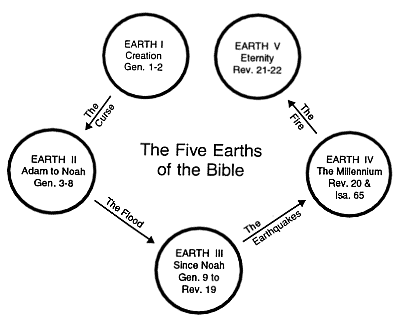
Earth I
The first earth was the one created in the beginning (Genesis 1:1). It was perfect in every respect (Genesis 1:31). But because of Man’s sin, God placed a curse upon the earth (Genesis 3:17-19).

The Bible indicates that this curse radically altered the nature of God’s original creation. Instead of Man exercising dominion over Nature, as originally planned (Genesis 1:26, 28), Nature rose up in conflict with Man, as poisonous plants, carnivorous animals and climatic cataclysms (like tornados) suddenly appeared.

Earth II
The curse radically altered the original earth, but Earth II was still quite different from the one we live on today. There is much Biblical evidence in both Genesis and Job that the second earth had a thick vapor canopy which shielded life from the ultraviolet radiation of the sun, producing the long life spans recorded in Genesis (see Genesis 2:5-6 and Job 38:8-11).

The whole earth was like a greenhouse with thick vegetation growing everywhere, even at the poles. There was also probably only one large land mass.

Once again the sinful rebellion of Mankind motivated God to change the nature of the earth (Genesis 6:11-13). The change agent this time was water. It appears that God caused the vapor canopy to collapse (Genesis 7:11). He also caused “fountains of the great deep” to break forth upon the surface of the earth (Genesis 7:11).

Earth III
Like the curse, the Flood radically altered the nature of the earth. It produced Earth III, the earth we now live on.

The earth tilted on its axis, forming the polar caps. The unified land mass was split apart, forming the continents as we now know them (which is why they fit together like a jigsaw puzzle — see Genesis 10:25). And the vapor canopy was so completely depleted that ultraviolet radiation began to reach the earth in unprecedented levels, resulting in greatly reduced life spans, first to 120 years and then to 70 years.

The Bible reveals that the current earth, Earth III, will be radically changed again at the Second Advent of Jesus. The change agents will be earthquakes on the earth and supernatural phenomena in the heavens.

The changes produced will so totally alter the earth and its atmosphere that Isaiah refers to “the new heavens and the new earth” which will exist during the reign of the Lord (Isaiah 65:17).

Earth IV
Earth IV — The millennial earth — will be very different from the present earth. The earthquakes that will produce it will be the most severe in history.

Every valley will be lifted, every mountain will be lowered, and every island will be moved (Revelation 6:12-14; 16:17-21). Jerusalem will be lifted up, and Mt. Zion will become the highest of all the mountains (Zechariah 14:10 and Micah 4:1).

The vapor canopy will likely be restored because life spans will be expanded to what they were at the beginning of time (Isaiah 65:20,22).

Further evidence that the vapor canopy will be restored is to be found in the fact that all the earth will become abundant once again with lush vegetation (Isaiah 30:23-26 and Amos 9:13-14). The Dead Sea will also become alive (Ezekiel 47:1-9).

Most important, the curse will be partially lifted, making it possible for Man to be reconciled to Nature and for Nature to be reconciled to itself. The wolf will dwell with the lamb because the wolf will no longer be carnivorous. The nursing child will play with the cobra because the cobra will no longer be poisonous (Isaiah 11:8).

Earth V
But Satan’s last revolt at the end of the Millennium will leave the earth polluted and devastated (Revelation 20:7-9). Thus, at the end of the Lord’s reign, God will take the Redeemed off the earth, place them in the New Jerusalem, and then cleanse the earth with fire (2 Peter 3:10-13).

In other words, God will superheat this earth in a fiery inferno and then reshape it like a hot ball of wax. The result will be the “new heavens and new earth” prophesied in Isaiah 66 and Revelation 21.

This will be Earth V, the perfected, eternal earth where the Redeemed will spend eternity in the New Jerusalem in the presence of God (Revelation 21:1-4). The curse will be completely lifted from this earth (Revelation 22:3).

Restoration in the Old Testament
God loves His creation, and He is determined to restore it to its original perfection.

This purpose of God was reflected in the rites of the Tabernacle of Moses. Each year when the High Priest entered the Holy of Holies to make atonement for the sins of the nation, he would sprinkle blood on the Mercy Seat of the Ark — and also on the ground in front of the Ark (Leviticus 16:15).

The blood on the Mercy Seat pointed to the promise of God that one day He would send a Messiah who would shed His blood so that the mercy of God could cover the Law and make it possible for us to be reconciled to our Creator. The blood on the ground pointed to the promise of God that the sacrifice of the Messiah would also make it possible for the creation to be redeemed.

In the Old Testament, Isaiah 11 gives us a beautiful picture of the redeemed creation during the Millennium. We are told that the meat eating animals will cease to prey on each other and “will eat straw like the ox.” The poisonous animals will also be transformed. They will cease to be dangerous (Isaiah 11:6-9; 35:9).

The plant kingdom will similarly be transformed back to its original perfection before the curse. The result will be incredible agricultural abundance:

“Behold, days are coming,” declares the Lord,
“When the plowman will overtake the reaper
And the treader of grapes him who sows seed;
When the mountains will drip sweet wine . . .”
— Amos 9:13

The prophet Joel adds that “the threshing floors will be full of grain, and the vats will overflow with the new wine and oil” (Joel 2:24).
The implication of these passages is that Man will no longer have to strive against nature because weeds and poisonous plants will cease to exist and rainfall will be abundant.

In fact, Isaiah tells us that areas of wilderness will be transformed into glorious forests (Isaiah 35:2) and deserts will become “springs of water” (Isaiah 35:7).

Restoration in the New Testament
The promise of a redeemed and restored creation is reaffirmed in the New Testament. Peter referred to the promise in his second sermon at the Temple in Jerusalem. He told his audience that Jesus would remain in Heaven until the time comes for the “restoration of all things” (Acts 3:21).

Paul elaborates the theme in Romans 8:18-23. He declares that the whole creation is in “slavery to corruption” (verse 21). This is a reference to what physicists call the Second Law of Thermodynamics; namely, that all of creation is running down, moving from order to disorder — that all of creation is in bondage to decay.

Paul then pictures the creation as a pregnant woman waiting anxiously for the moment of delivery when the curse will be lifted and the creation will be redeemed. He says that will occur at “the revealing of the sons of God.”

That is a reference to the resurrection of the saints, a point he makes clear in verse 23 when he says that the saints should yearn with nature for that same event because that is when each of us will receive “the redemption of our body.”

The Eternal Earth
The Old Testament has little to say about the eternal earth which God will create at the end of the Millennium. Isaiah simply asserts that such an earth will be provided (Isaiah 66:22). Isaiah’s only other reference to a “new earth,” in Isaiah 65:17, is a reference to the renovated earth of the Millennium.

In Revelation 21 the apostle John gives us the most detailed look at what the new, eternal earth will be like. And yet, his description is tantalizingly vague. He makes a cryptic reference to the fact that there will no longer be any sea (Revelation 21:1). Beyond that, all he tells us is that God will make “all things new” (Revelation 21:5).

A Glorious Blessing
I think the reason the passages about the eternal earth tell us so little about the features of that earth is because they focus on one glorious fact that overshadows any concern with what the new earth will be like. That fact is that the Redeemed will live in the presence of Almighty God (Revelation 21 and 22). We will “serve Him” and we will “see His face” (Revelation 22:3-4). What the earth will be like pales in comparison to this revelation.
The Wrath of God – Is it a Myth or a Reality? by Dr. David R. Reagan

A popular radio talk show host on an Oklahoma City secular station recently interviewed me live on the air via telephone. He had seen an article I had written about the financial accountability of Christian ministries, and he had liked it.

He began the interview by graciously giving me the opportunity to talk non-stop for about ten minutes about the way God had transformed my life and called me into the ministry. We then moved on to a discussion of the scandals that had recently rocked the Christian community nationwide.

The Unmentionable Word
Everything went well until the host asked me to summarize the fundamental message of my ministry. I responded by saying that God had called me to proclaim “the soon return of Jesus in wrath.”

Before I could proceed with my explanation, the announcer cut me short. “What do you mean, ‘wrath’?” he asked.

“I mean that Jesus is going to return very soon to pour out the wrath of God upon those who have rejected God’s love and grace and mercy.”

“Your God is a monster God!” he snapped. He then added, “I happen to be a Christian, and I can tell you that my God wouldn’t hurt a flea!”

That was the end of the interview. He hung up on me. I was not given an opportunity to respond to his blasphemy of God.

Satan’s Grand Deception
The radio host’s vehement response to the wrath of God did not surprise me. It is characteristic of both Christians and non-Christians, and I have encountered it many times.

Satan has sold the world a bill of goods concerning the nature of God. Most people, both Christian and non-Christian, tend to view God as being a sort of cosmic teddy bear.

They see Him as big and warm and soft, full of infinite love and forgiveness. He couldn’t hurt a fly, and He certainly wouldn’t be so cruel as to condemn or harm any beings created in His own image. On the Day of Judgment, God will simply give everyone a big hug and wink at their sins.

The only problem with this wonderfully comforting image is that it is a lie straight from the pit of Hell.

The True God
Yes, the Bible teaches that God is loving, patient, caring, and forgiving (Psalms 86:15 and John 3:16). As the apostle John put it, “God is love” (1 John 4:8).

Two of my favorite passages in the Bible emphasize the personal loving nature of God. One was penned by the apostle Peter. In 1 Peter 5:6-7 he says that we are to cast all our anxieties upon God “because He cares for you.” That is a very comforting thought.

The other passage that I love to read over and over consists of words spoken by the prophet Jeremiah in Lamentations 3:22-24 (RSV):

“The steadfast love of the Lord
never ceases,
His mercies never come to an end;
They are new every morning;
Great is Thy faithfulness,
‘The Lord is my portion,’ says
my soul,
‘Therefore I will hope in Him.”

But the Bible also clearly teaches that there is another aspect of God’s character that is equally important. It is the aspect that Satan wants us to ignore, and he has been very successful in prompting ministers to overlook it. After all, it doesn’t produce popular sermons! I’m speaking, of course, of the holiness of God (Leviticus 11:44; Isaiah 6:3; 1 Peter 1:16).

Grace or Wrath?
The Bible teaches that God is perfectly holy. Because of this attribute of His character, He cannot tolerate sin (Numbers 14:18). The Bible says God must deal with sin, and He does so in one of two ways — either grace or wrath.

Every person on the face of this earth is at this moment under either the grace of God or the wrath of God. Jesus Himself made this point in His discourse with Nicodemus.

In the same conversation in which Jesus spoke the glorious words about God’s love in John 3:16, He also spoke of God’s wrath in a verse that we like to ignore: “He who believes in the Son has eternal life, but he who does not obey the Son shall not see life, but the wrath of God abides on him” (John 3:36).

The apostle Paul emphasized this point in his preaching and teaching. In Ephesians 5 he warns against immorality, covetousness, and idolatry, and then he adds this observation: “Let no one deceive you with empty words, for because of these things, the wrath of God comes upon the sons of disobedience” (Ephesians 5:6).

We come under God’s grace by placing our faith in Jesus and appropriating His atoning sacrifice for our lives ( 1 John 1:7). There is no salvation apart from Jesus (Acts 4:10-12). Those who have rejected God’s free gift of grace in Jesus are under God’s wrath (John 3:36), and they have no one to blame but themselves.

The Coming Wrath
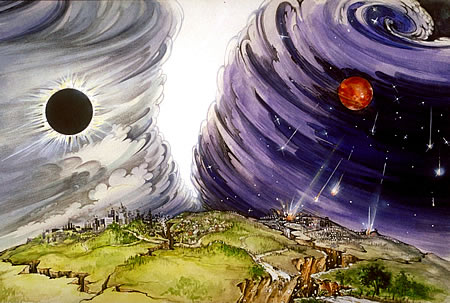
God’s wrath will fall when Jesus returns (Jude 14-15). The passage in Revelation which pictures the return of Jesus says that He will return in righteousness to “judge and wage war” (Revelation 19:11).

The first time Jesus came, He came in loving compassion with eyes filled with tears. But when He returns, He will come in vengeance (Revelation 6:12-17), with eyes like a flame of fire (Revelation 19:12). He will come to destroy the enemies of God (Revelation 19: 11).

The presidents and kings and prime ministers of the world will get on their knees and cry out for the rocks and mountains to fall upon them, so great will be the terror of the Lord (Revelation 6:15-17). The unrighteous will stumble about like blind men, and their blood will be poured out like dust (Zephaniah 1:17).

The Meaning of Wrath
Does this make God a “monster”? No! On the contrary, it proves His goodness, for how could a good God ignore the evil of sin and allow it to go unpunished? His wrath against evil will demonstrate His righteousness.

The prophet Nahum summed it up best. Writing of the love of God, he said, “The Lord is good, a stronghold in the day of trouble, and He knows those who take refuge in Him” (Nahum 1:7). But a few verses earlier Nahum had also spoken of the holiness of God:

“The Lord is avenging and wrathful.
The Lord takes vengeance on His
adversaries,
And He reserves wrath for His enemies.
The Lord is slow to anger and great
in power,
And the Lord will by no means leave
the guilty unpunished.”
— Nahum 1:2-3

God’s wrath is never motivated primarily by a desire to punish. Rather, it is designed to bring people to repentance so that they might be saved. Even in His wrath, God remembers mercy.

God demonstrates His mercy in wrath by never pouring out His wrath without warning. He tried to warn Sodom and Gomorrah through Abraham. He warned Noah’s world through the preaching of Noah for 120 years. He sent both Jonah and Nahum to warn the pagan city of Ninevah.

Consider too how He sent prophet after prophet to call the nations of Israel and Judah to repentance:

“And the Lord, the God of their fathers, sent word to them again and again by His messengers, because He had compassion on His people and on His dwelling place; but they continually mocked the messengers of God, despised His words and scoffed at His prophets, until the wrath of the Lord arose against His people, until there was no remedy.” — 2 Chronicles 36:15-16

God’s mercy in wrath is also manifested in the fact that He always leads up to His final outpouring of wrath through a series of progressive judgments. These judgments are outlined in detail in Deuteronomy 28:15-57.

This characteristic of God’s wrath is demonstrated in the prophecies concerning the Tribulation. Rather than simply pouring out His wrath on the rebellious nations of the world, destroying them in one instant of overwhelming catastrophe, He subjects the world to a series of judgments that sequentially increase in scope and intensity (Revelation 6,8-9,16).

Although most people refuse to repent in response to these judgments (Revelation 9:20-21), there is “a great multitude, which no one could count, from every nation and all tribes and peoples and tongues” who do repent and respond to Jesus in faith (Revelation 7:9).

These radically different responses to the wrath of God illustrate the point that is often made by Billy Graham: “The same sun that melts the butter also hardens the clay.” The wrath of God melts some hearts in repentance, but it has the effect of hardening the hearts of many others.

Wrath and the Redeemed
Many Christians respond negatively to Bible prophecy. It’s not at all unusual to hear a Christian say something like this: “I don’t want to hear anything about prophecy because it’s too full of gloom and doom.”

Well, there is a lot of gloom and doom for those who refuse to respond to God’s gift of love in Jesus. But there is only good news for the Redeemed.

The Old Testament ends with a passage that presents both the gloom and the joy of end time prophecy. Malachi says that when the Lord returns, the day will be “like a furnace; and all the arrogant and every evildoer will be chaff” (Malachi 4:1). That’s the bad news.

But consider the good news: “But for you who fear My name, the sun of righteousness will rise with healing in its wings; and you will go forth and skip about like calves from the stall” (Malachi 4:2).

There is no reason for any child of God to fear the wrath of God. Paul wrote that since we have been justified by the blood of Christ, “we shall be saved from the wrath of God through Him” (Romans 5:9). And in a most comforting verse, Paul told the Thessalonians that Jesus will “deliver” the Redeemed “from the wrath to come” (1 Thessalonians 1:10). The reason, Paul explained, is that “God has not destined us for wrath, but for obtaining salvation through our Lord Jesus Christ” (1 Thessalonians 5:9).

A Plea
Are you under grace or wrath? The choice is yours. Jesus is coming soon. When He appears, will He be your Blessed Hope or your Holy Terror? Will you cry for the mountains to fall upon you? Or, will you go forth leaping with joy like a calf released from a stall?

God loves you and He wants you to accept His Son as your Savior so that you will come under grace and can participate in an event described by Isaiah:

“And the ransomed of the Lord will return,
And come with joyful shouting to Zion,
With everlasting joy upon their heads.
They will find gladness and joy,
And sorrow and sighing will flee away.”
(Isaiah 35:10)